Arthur Hayes Says AI Bust Could Fuel Bitcoin as He Pitches FLOP
Arthur Hayes sees an AI investment bust paving the way for Bitcoin-friendly liquidity and cheaper computing, the foundation of his FLOP agent network.
Key Notes
- Arthur Hayes expects excess AI infrastructure to lower computing costs and sees a potential bailout as a source of liquidity for Bitcoin and other crypto assets.
- His FLOP project aims to let AI agents purchase inference from GPU providers, connecting the proposed currency with the computing work agents consume.
- FLOP’s draft documents target a fourth-quarter 2026 testnet and first-quarter 2027 mainnet, while the AI crash and policy response remain forecasts.
Arthur Hayes says an eventual collapse in AI investment could create a favorable backdrop for Bitcoin if governments respond with fresh liquidity. At the same time, he expects the computing infrastructure left behind to make AI agents cheaper to operate, supporting the market his FLOP project is trying to build.
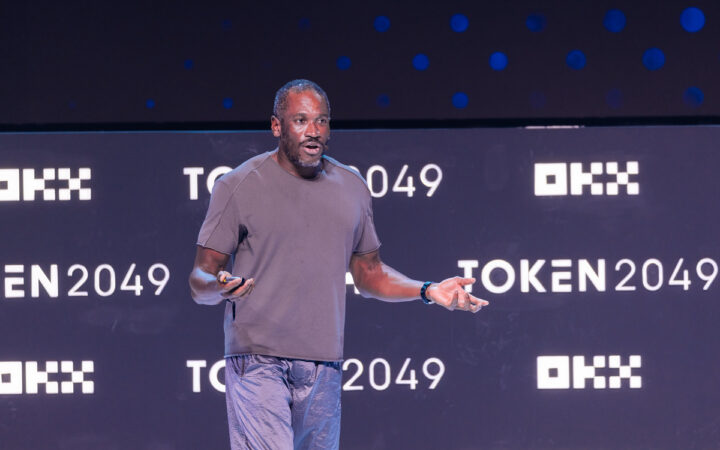
The Maelstrom chief investment officer brought that argument to TOKEN2049 Singapore on October 7. The conference’s official agenda listed his keynote as “FLOP Bigger Than Bitcoin,” putting a proposed AI-agent currency at the center of his appearance.
ChainCatcher’s speech transcript, which the outlet says was compiled with AI, describes Hayes challenging the economics of major AI laboratories while arguing that the technology itself will survive an investment bust. His separate remarks to CNBC explain the potential link to Bitcoin more directly.
Hayes Sees an AI Buildout Running Ahead of Demand
In a CNBC interview at the Gamma Prime Investing Conference in Singapore, Hayes argued that the data-center construction boom could leave computing power abundant and inexpensive. His concern is whether the companies committing to buy that capacity can generate enough revenue to pay for it.
He placed a potential test in late 2027 or 2028, when new facilities are delivered and customers face their computing commitments. That is his forecast for when financial pressure could emerge, rather than a confirmed timetable for an AI market crash.
Hayes also acknowledged an alternative: AI could become useful enough over the next year for demand and profitability to catch up. He distinguished the laboratories from suppliers already earning money, including Nvidia and memory-chip producers, and said shorting AI companies was not an attractive opportunity to him.
The Bitcoin Argument Depends on the Policy Response
Hayes developed the liquidity mechanism in his September essay Safety First. He outlined two possible responses to weaker AI economics: government purchases of computing capacity or financial support for institutions exposed to AI-related debt.
Under his scenario, either route could expand dollar liquidity and encourage financial speculation, benefiting Bitcoin and other crypto assets. He also argued that falling demand for computing services would put pressure on debt that remains payable even when the underlying infrastructure earns less than expected.
CoinScreamer’s earlier coverage examined that AI debt thesis. The new conference appearance connects his macroeconomic outlook with a product designed to benefit from the resulting supply of computing power.
The positive Bitcoin outcome depends on several assumptions: that AI financing becomes stressed, that authorities intervene and that the intervention translates into additional demand for crypto. Hayes’s argument concerns the response to a downturn; it does not establish that an initial selloff would leave Bitcoin untouched.
Cheaper Compute Could Outlast Failed Investments
At TOKEN2049, Hayes argued that losses for infrastructure investors would not eliminate AI’s usefulness. According to ChainCatcher’s transcript, he expects excess capacity to reduce the cost of running agents and allow them to handle more demanding tasks.
That separates the investment cycle from adoption of the underlying technology. In his view, an unprofitable buildout can still leave behind resources that support new businesses. The forecast offers a second potential beneficiary alongside Bitcoin: services that purchase computing power.
FLOP Tries to Turn Currency Into AI Inference
The concept predates this week’s speech. In his August 19 essay The Book of Genesis, Hayes proposed a decentralized marketplace where agents pay a native currency for a specified amount of computation within a defined period.
His premise is that an agent needs computing power to perform useful work, and a currency that buys that resource could also become useful for commerce between agents. He described miners earning FLOP through both network rewards and fees for executing inference, the process of running a trained AI model.
The essay also disclosed that Hayes funded the development team himself. His role matters when assessing the pitch: the project is an entrepreneurial bet on his own AI outlook, and its claimed future network value is promotional reasoning rather than a demonstrated valuation.
The proposed marketplace must attract both computing suppliers and paying users. Cheaper GPUs or abundant data-center capacity could reduce costs, but they would not by themselves establish demand for a particular network or its currency.
Draft Documents Keep the Launch in the Future
FLOP’s current whitepaper is marked as a draft for review and lists a fourth-quarter 2026 testnet and first-quarter 2027 mainnet. These remain development targets, rather than completed launches.
The document distinguishes proof of useful inference, which verifies work and influences rewards and validator eligibility, from AlephBFT, the proposed consensus mechanism. Its architecture assigns GPU work to miners and block production to validators.
The project’s documentation likewise cautions that individual mechanisms are at different stages of implementation. The design describes what the network aims to deliver; it should not be read as proof that those features already operate at production scale.
Other approaches to crypto-funded AI services are already taking shape. CoinScreamer covered Ethereum’s zkAPI launch, which separates API requests from the wallet funding them. FLOP addresses a different question: how agents could buy inference from a network of computing providers.
For Hayes’s thesis, the practical tests are now clearer than the headline forecast: whether AI revenues can support infrastructure commitments, whether surplus capacity lowers inference prices, and whether FLOP can convert that cheaper supply into a working market.
Disclaimer: CoinScreamer is an independent media brand owned and operated by NuvexMedia LLC, publishing news, research, and market insights on digital assets and related technologies. NuvexMedia LLC invests in and collaborates with companies across the digital asset, blockchain, and technology sectors. These relationships do not influence CoinScreamer’s editorial coverage, and the publication maintains full editorial independence to provide accurate, timely, and objective information. © 2025 NuvexMedia LLC. All rights reserved. This content is for informational purposes only and should not be considered legal, tax, investment, financial, or other professional advice.