Key Notes
- Heatbit’s Bitwater replaces a heating element in a compatible electric water tank and uses 20 BM1370 Bitcoin-mining chips.
- The company advertises up to 34 TH/s and power consumption up to 600 watts, with performance varying by operating settings.
- The $899 Genesis-batch preorder targets US and Canadian customers, with first shipments expected in Q1 2027.
Heatbit has unveiled Bitwater, a $899 water-heater element that uses Bitcoin-mining chips to warm the water in an existing electric tank. The company is taking preorders for a first production batch, with shipments expected in the first quarter of 2027.
The device contains 20 BM1370 ASIC chips, specialized processors built for mining Bitcoin. Heatbit’s October 22 announcement advertises up to 34 terahashes per second of computing power, efficiency starting at 12 joules per terahash and power consumption of up to 600 watts. Those are manufacturer specifications, rather than independently verified operating results.
Bitcoin Miner Inside an Existing Water Tank
Bitwater is a replacement heating element, rather than a complete boiler or a new water-heater tank. Instead of relying only on a conventional resistance wire, it transfers heat generated by the mining chips into the surrounding water.
Heatbit says the initial version is designed for electric storage tanks commonly used in the United States and Canada: tanks holding 30 to 80 US gallons with a standard one-inch NPSM screw-in element port. Compatibility depends on the tank; the company offers a fit check rather than claiming that every water heater will accept it.
In a two-element tank, Bitwater replaces the lower element. The existing upper element and its thermostat remain in place to meet heavier hot-water demand. The product’s 600-watt rating should therefore not be read as a claim that it replaces the full heating capacity of every household tank.
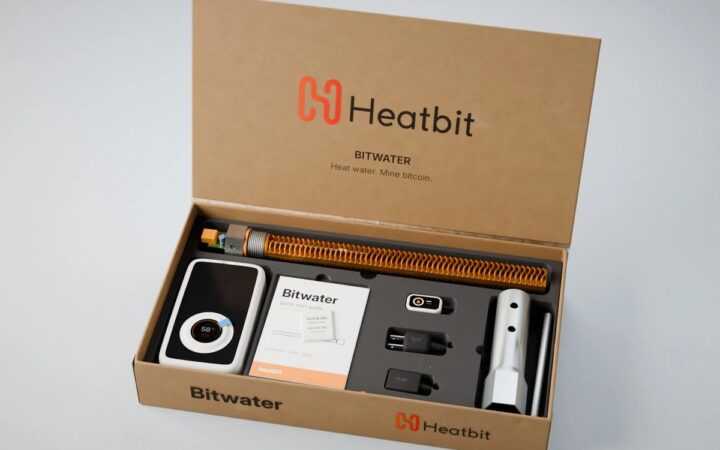
The kit includes the mining element, a controller, a power cord, an element wrench, a guide and a leak sensor. The controller connects to a grounded wall outlet, while the companion app is intended to show water temperature, hashrate and mining earnings.
What the Advertised Mining Figures Mean
The 34 TH/s ceiling means up to 34 trillion hashing calculations per second. The efficiency figure measures electricity used per terahash, with a lower number indicating less energy consumed for a given amount of mining work.
Heatbit describes an automatic tuning system that changes chip frequency and voltage, moving between higher hashrate and better efficiency. Its maximum hashrate, minimum joules-per-terahash figure and maximum power draw describe advertised operating limits; the announcement does not establish that all three are achieved simultaneously at one setting.
Water cools the chips, removing the need for cooling fans, according to the company. Heatbit also says the design targets more than 80% utilization. Actual runtime will depend on the household’s hot-water requirements and operating settings, so that target is not a promise of uninterrupted mining.
The app is designed to let owners choose solo or pool mining and direct Bitcoin payouts to an address they control. Solo mining offers highly irregular rewards for a small device; pool participation distributes mining proceeds under the chosen pool’s terms.
Useful Heat Does Not Guarantee a Profit
The economic idea is to reuse heat that a miner would otherwise need to get rid of. If that heat replaces electricity already being used by a resistance water heater, mining could provide an additional return from part of the household’s existing energy spending.
That does not make the electricity free or establish a payback period for the $899 purchase. Earnings depend on Bitcoin’s price, network difficulty, time spent mining and any pool charges. The value of the recovered heat also depends on whether the household actually needs it and what heating system it replaces.
Heat reuse is already being explored at a larger scale. CoinScreamer previously covered Canaan’s pilot to use heat from mining servers in Canadian greenhouses. Bitwater applies the same broad principle to a household tank, although the products, operators and operating conditions are separate.
Preorders Target the US and Canada
Heatbit’s product page lists the Genesis batch at $899, with later batches priced at up to $1,299. The preorder is refundable under the company’s terms, and the stated first-shipment window is January through March 2027.
Initial shipping is limited to the United States and Canada. Versions for gas and heat-pump systems are described as future plans, not products available in this launch.
On certification, Heatbit says the element and support unit will ship already listed for the US and Canadian markets. That is a commitment about the shipping product; the announcement does not by itself verify a current third-party listing or independently establish the device’s safety and performance.
Disclaimer: CoinScreamer is an independent media brand owned and operated by NuvexMedia LLC, publishing news, research, and market insights on digital assets and related technologies. NuvexMedia LLC invests in and collaborates with companies across the digital asset, blockchain, and technology sectors. These relationships do not influence CoinScreamer’s editorial coverage, and the publication maintains full editorial independence to provide accurate, timely, and objective information. © 2025 NuvexMedia LLC. All rights reserved. This content is for informational purposes only and should not be considered legal, tax, investment, financial, or other professional advice.