Tokenization Is More Than Putting Assets on Blockchain: Interview with WeFi Co-Founder Maksym Sakharov
WeFi Co-Founder Maksym Sakharov believes tokenization's real potential lies not in putting assets on a blockchain, but in transforming how financial systems work together.
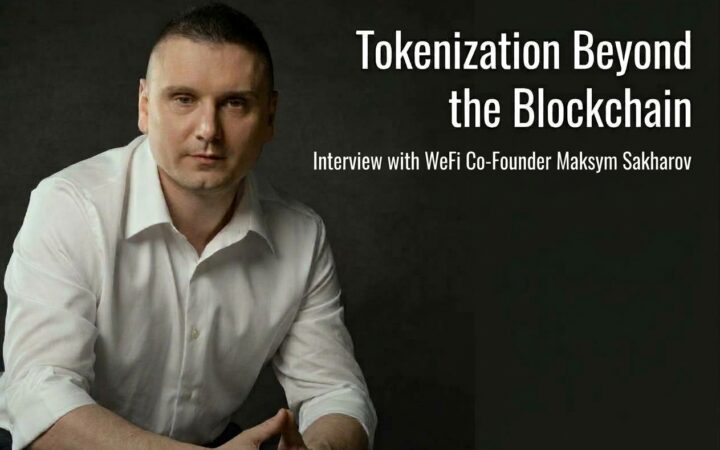
As financial institutions explore tokenized assets, stablecoins, and programmable money, the real challenge is moving beyond digital ownership to building infrastructure that connects financial systems. We talked to Maksym Sakharov, co-founder and Group CEO of WeFi, who explained why interoperability, liquidity, and capital efficiency will shape the next stage of institutional adoption.
By representing assets on programmable digital infrastructure, financial institutions hope to streamline operations, improve capital efficiency, and make it easier for capital to move between different financial functions. Major players, including BlackRock, Franklin Templeton, and JPMorgan, have shown growing interest in the space.
But a token is not the same as a liquid market, and issuing a digital asset does not automatically make it easier to trade or use as collateral. The technology may be ready before the surrounding financial infrastructure is.
For WeFi, which focuses on programmable financial infrastructure rather than tokenized financial products, this distinction is central to understanding where the industry is heading.
Q: Tokenization has become one of the dominant narratives in finance. Maksym, in your view, is it a genuine structural shift or mostly a rebranding of existing products?
It is a genuine structural shift, but not for the reason most people assume. The discussion often focuses on whether assets can be represented digitally, when the more important question is whether they operate differently once they are tokenized. Simply recording ownership on a blockchain does not fundamentally change finance. Changing how assets settle, interact with liquidity, serve as collateral, and move between institutions does.
I think tokenization is best understood as an infrastructure transition rather than a product transition. Financial markets have been digital for decades, but they still rely on separate systems coordinating payments, settlement, custody, and compliance. Tokenization becomes valuable when it allows those processes to operate within shared programmable infrastructure instead of across disconnected platforms.
Q: How would you explain what WeFi does and where you sit in the tokenization landscape?
WeFi builds financial infrastructure rather than tokenized financial products. Our role is to help create the operating environment where tokenized assets, payments, and financial services can function together as part of programmable financial systems. That places us below the application layer and closer to the infrastructure that allows financial institutions to coordinate capital more efficiently.
Many companies in the tokenization ecosystem focus on issuing assets or creating investment products. Those are important developments, but they represent only one part of the broader transformation. As tokenized deposits, stablecoins, investment funds, and real-world assets become more common, institutions also need infrastructure capable of supporting settlement, liquidity management, interoperability, and financial automation across those different asset types.
That is where WeFi contributes. We are focused on building infrastructure that provides programmable financial operations rather than simply supporting token issuance. From our perspective, tokenization delivers its greatest value when assets can interact with payments, collateral, treasury, and settlement processes inside a common operating environment.
Q: What is the biggest piece of infrastructure still missing for tokenized assets to scale?
The biggest gap is not technology. It is interoperability between financial infrastructure. Today, many tokenization projects operate successfully within their own environments, but financial markets do not function as isolated ecosystems. Banks, custodians, payment providers, asset managers, and market infrastructure all need to exchange value continuously. If tokenized assets cannot move efficiently across those participants while remaining compatible with existing regulatory and operational frameworks, scale will remain limited regardless of how many assets are issued.
This is why many recent institutional initiatives have focused less on creating new tokenized products and more on shared settlement infrastructure. Projects such as the Bank for International Settlements’ Project Agorá illustrate this direction by exploring how tokenized commercial bank deposits and central bank money can operate within coordinated infrastructure rather than separate systems. That reflects a broader industry recognition that infrastructure must evolve alongside assets.
I think the next stage of tokenization will be determined less by issuance and more by integration. Institutions already know how to tokenize assets. The larger challenge is allowing those assets to move, settle, provide collateral, and interact across financial markets with the same reliability, legal certainty, and operational efficiency that institutions expect from today’s infrastructure. That is ultimately an interoperability challenge, not a tokenization challenge.
Q: Liquidity is often cited as the promise of tokenization, yet many tokenized assets barely trade. Why, and what would fix it?
Tokenization does not create liquidity on its own. It improves the infrastructure through which liquidity can move, but it cannot manufacture demand for an asset that investors do not already want to own. That is an important distinction because liquidity is ultimately a function of market participants, not technology. Many tokenized assets today still operate in relatively closed ecosystems with limited investor access, fragmented trading venues, and inconsistent settlement standards. Even if the asset itself is tokenized, the surrounding market infrastructure often remains disconnected. As a result, the asset may be easier to issue than to trade efficiently.
Improving liquidity therefore requires more than increasing the number of tokenized assets. It requires broader participation, standardized infrastructure, and greater interoperability between trading, settlement, and custody. Just as importantly, institutions need confidence that tokenized assets can integrate into existing treasury, collateral, and risk management processes rather than operate as standalone products.
Q: Where does onchain liquidity come from for assets that were illiquid to begin with, such as private credit, real estate, and private equity?
The short answer is that it doesn’t appear automatically. Tokenization does not transform an illiquid asset into a liquid one simply because ownership is recorded differently. If the underlying asset trades infrequently, that economic reality remains.
What tokenization can change is the efficiency with which existing capital interacts with those assets. Better settlement, greater transparency, programmable collateral, and broader market access can reduce some of the operational barriers that discourage participation today. Over time, those improvements may attract more buyers and sellers, but the liquidity still comes from investors allocating capital, not from the technology itself.
This is particularly relevant for private markets. Investors are often less constrained by the quality of the assets than by the operational complexity of accessing, financing, and managing them. If programmable infrastructure lowers those barriers, more institutions may find these markets commercially attractive. That broadens participation, which in turn supports deeper liquidity.
Q: How do you see the relationship between stablecoins, tokenized money market funds, and tokenized deposits? Do they compete or converge?
I see them as complementary components of the same financial infrastructure rather than competing products. They solve different problems, but together they create a more complete operating environment for programmable finance.
Stablecoins have become the payment and settlement layer. Their primary role is allowing value to move efficiently between participants and applications. Tokenized deposits extend regulated banking infrastructure into programmable environments while preserving the relationship between customers and commercial banks. Tokenized money market funds, meanwhile, provide an investment layer where capital can remain productive while retaining many of the operational advantages of digital infrastructure.
Taken individually, each addresses a specific use case. Together, they begin to resemble the financial architecture institutions already understand, but redesigned around programmable infrastructure instead of disconnected systems. That is why I believe convergence is more likely than competition.
Q: Can you give an example of a tokenized asset doing something it couldn’t do in traditional finance, such as serving as collateral, being lent against, or being composable with other products?
I would actually challenge the premise slightly. Many of these activities already exist in traditional finance. Assets have long been used as collateral, lent against, or incorporated into broader financial structures. What tokenization changes is not what assets can do, but how efficiently they can do it.
Take a tokenized money market fund as an example. Traditionally, moving that asset between investment, collateral, and settlement functions often involves separate systems, multiple intermediaries, and time delays. Within programmable financial infrastructure, the same asset can remain invested while simultaneously becoming available for collateral management or other predefined financial operations, with far less operational coordination between institutions. Capital efficiency is becoming increasingly important for financial institutions. Assets that can move more easily between different financial functions reduce idle capital, shorten operational timelines, and improve liquidity management. The value comes from making existing financial processes work together more effectively rather than creating entirely new financial products.
Q: What does the next 2–3 years of institutional adoption look like? Which asset classes move first?
I don’t think institutional adoption will happen evenly across every asset class. It will occur where tokenization produces measurable operational advantages before expanding more broadly. That means institutions are likely to prioritize assets that already have established demand, standardized structures, and clear settlement requirements.
We are already seeing that pattern emerge. Tokenized money market funds, government securities, stablecoins, and tokenized deposits have attracted significant institutional attention because they sit close to the core of financial operations. These instruments support payments, treasury management, liquidity, and collateral, making improvements in infrastructure immediately valuable. By contrast, more complex or less standardized assets such as private equity or commercial real estate may take longer because improving infrastructure alone does not solve their underlying market characteristics.
I expect the conversation to shift from tokenizing individual assets to connecting financial systems. The next phase will be less about launching additional pilots and more about integrating tokenized assets into existing banking, custody, and settlement infrastructure. Institutions will increasingly evaluate tokenization alongside broader modernization initiatives rather than treating it as a separate innovation project.
Q: What will convince a skeptical bank or asset manager to move from pilots to production?
The deciding factor will not be the technology itself. It will be a clear commercial case supported by measurable operational improvements.
Financial institutions have spent the last several years proving that tokenization is technically feasible. The next stage is demonstrating that it improves settlement, reduces operational complexity, increases capital efficiency, or strengthens liquidity management in ways that justify long-term investment. That is a very different question from asking whether blockchain works.
Regulatory clarity also plays an important role, but regulation alone will not drive adoption. Banks and asset managers modernize infrastructure when they can see tangible business benefits that outweigh implementation costs and operational risks. That is why many institutions are increasingly focusing on tokenized deposits, programmable settlement, and stablecoin infrastructure rather than launching isolated tokenization initiatives.
Ultimately, production adoption begins when tokenization stops being treated as an innovation project and starts being evaluated like any other piece of financial infrastructure. When executives see measurable improvements in efficiency, coordination, and capital deployment, the discussion naturally shifts from experimentation to implementation.
Q: What is the single biggest misconception about tokenization that you would like to correct?
The biggest misconception is that tokenization is primarily about putting assets on blockchain networks.
That view focuses on the representation of the asset rather than the financial system around it. Markets have been digital for decades. The real challenge has never been creating digital records. It has been coordinating payments, settlement, custody, liquidity, and compliance across multiple institutions operating different systems. Tokenization only becomes meaningful when it improves that coordination.
Tokenization’s long-term value will depend less on issuing digital assets than on connecting them to payments, settlement, custody, and liquidity infrastructure. If these connections deliver measurable efficiency gains without overstating liquidity benefits, tokenization could become a lasting part of institutional finance.
We thank Maksym Sakharov for taking the time to share his perspective on the future of tokenization and institutional finance.
Disclaimer: CoinScreamer is an independent media brand owned and operated by NuvexMedia LLC, publishing news, research, and market insights on digital assets and related technologies. NuvexMedia LLC invests in and collaborates with companies across the digital asset, blockchain, and technology sectors. These relationships do not influence CoinScreamer’s editorial coverage, and the publication maintains full editorial independence to provide accurate, timely, and objective information. © 2025 NuvexMedia LLC. All rights reserved. This content is for informational purposes only and should not be considered legal, tax, investment, financial, or other professional advice.