
On 29 July 2014, Trezor shipped the Model One, establishing the hardware wallet category and offering ordinary individuals a reliable method to manage their private keys offline. Before its introduction, securing Bitcoin required a spare computer, Linux expertise, and significant technical confidence. Because few users possessed all three, most stored their holdings on centralized exchanges and hoped for the best.
The idea originated in 2011. Marek “Slush” Palatinus was running the first Bitcoin mining pool single-handedly while considering how individuals could safely store their coins. Late that year, prior to Prague’s inaugural Bitcoin conference, Palatinus met Pavol “Stick” Rusnák, an open-source and security engineer, at the Brmlab hackerspace. Rusnák secured his funds using an air-gapped Linux laptop running the Electrum wallet. While functional for an engineer, the process was far too complex for everyday users.
Alongside Alena Vránová, the group sought a solution simple enough for non-technical users, setting a goal, half as a joke, to create a device their parents could operate. Rather than attempting to secure an entire personal computer, the logical path was to move the private key onto a dedicated physical device that signs transactions in isolation without exposing keys to the internet.
Hackerspace Prototypes and Direct-to-Community Funding
The team built their first operational prototype at Brmlab in 2012. By 2013, confident in the concept, they established a company around it. After Kickstarter rejected the project, the founders decided against venture capital and chose to self-fund by running pre-orders paid exclusively in bitcoin.
Expecting modest demand of around 1,000 units from Bitcoin Talk forum participants, they faced manufacturing constraints when suppliers demanded a minimum order of 30,000 units. The team committed to the order and produced an initial batch of approximately 13,000 devices. The Model One priced at one Bitcoin, worth roughly 80 dollars at the time.
Engineering the physical enclosure proved far more difficult than the electronics. While Rusnák’s initial circuit board design succeeded on the first attempt, crafting the compact plastic casing required extremely tight tolerances, becoming the project’s primary technical bottleneck.
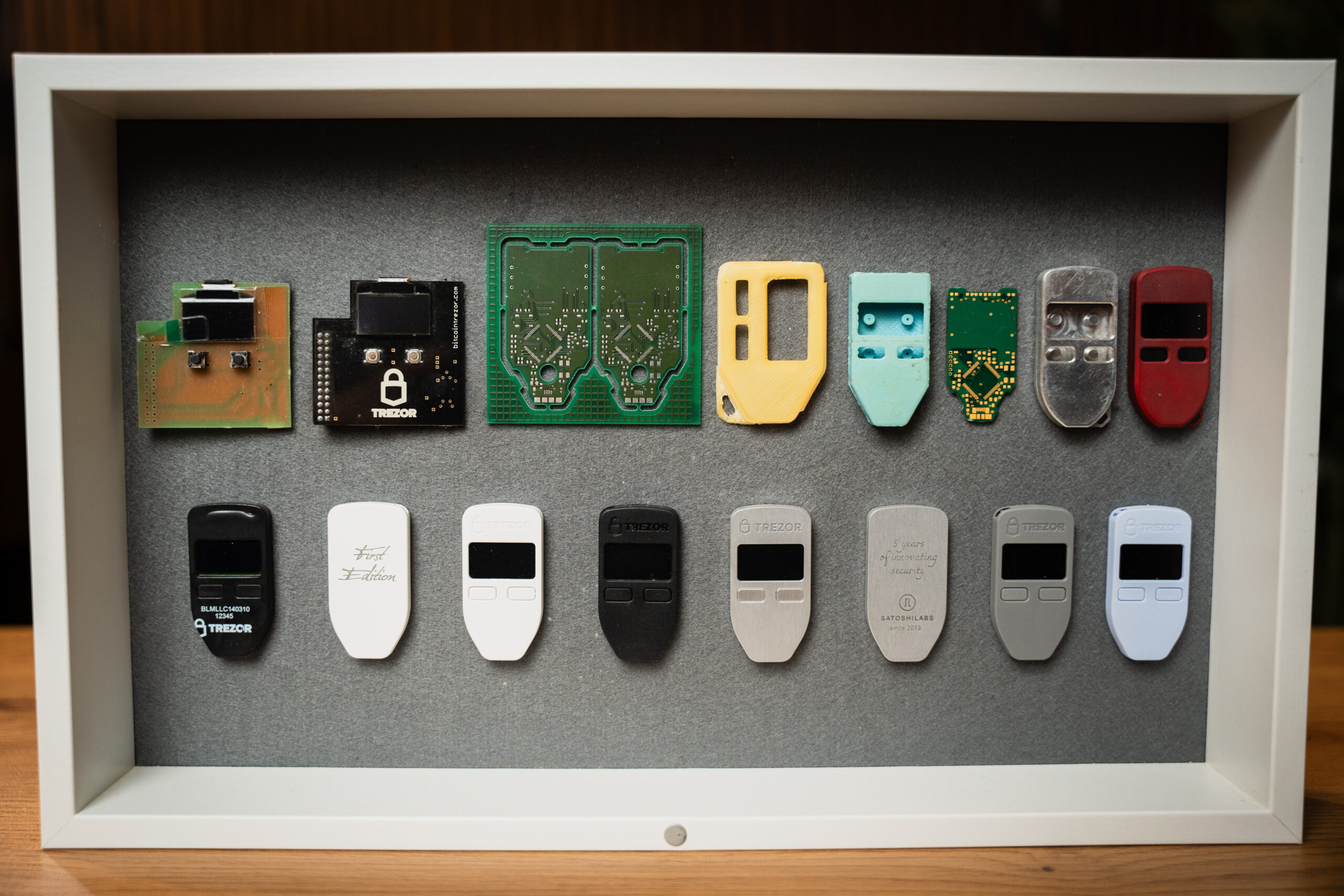
Trezor Model One Evolution. Photo: Trezor
Evolving Challenges in Modern Self-Custody
Twelve years after creating the category, Trezor continues to operate under its founding principles: fully open-source code, independent self-funding, and user-controlled private keys. While early manufacturing relied on 3D-printed cases, modern iterations like the Trezor Safe 7 feature RedDot Award-winning designs and quantum-ready security features.
However, the core challenge facing self-custody has shifted from technical feasibility to user experience. Co-founder Pavol Rusnák notes that while convincing users that self-custody was possible dominated early discussions, usability now determines adoption. Historically, centralized custodial apps maintained an edge due to substantial design budgets.
Today, rising regulatory mandates have added complexity to custodial exchanges, making self-custody increasingly straightforward by comparison. By focusing on intuitive design alongside robust open-source security, Trezor aims to make holding one’s own keys the simplest and safest option for digital asset holders worldwide.
Disclaimer: CoinScreamer is an independent media brand owned and operated by NuvexMedia LLC, publishing news, research, and market insights on digital assets and related technologies. NuvexMedia LLC invests in and collaborates with companies across the digital asset, blockchain, and technology sectors. These relationships do not influence CoinScreamer’s editorial coverage, and the publication maintains full editorial independence to provide accurate, timely, and objective information. © 2025 NuvexMedia LLC. All rights reserved. This content is for informational purposes only and should not be considered legal, tax, investment, financial, or other professional advice.