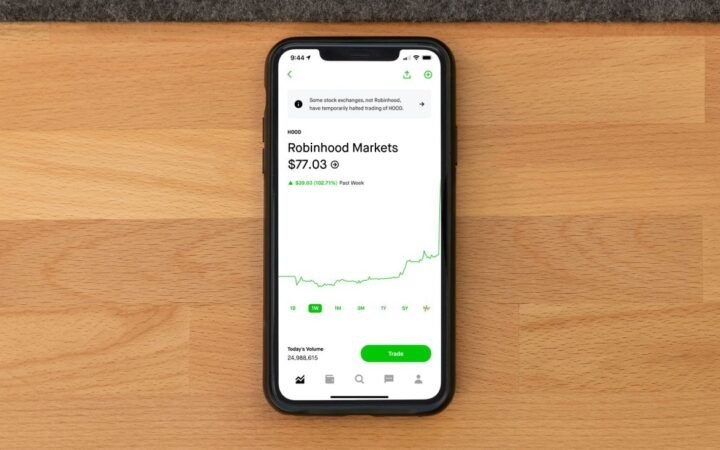
Robinhood

Robinhood

Robinhood is a publicly traded financial technology and brokerage company focused on mobile-first retail brokerage spanning equities, options, crypto, retirement, cash, and newer event-contract products.

Trading, Brokers & Market Makers
  • Founded 2013
  • Headquarters Menlo Park, California, United States
  • CEO Vlad Tenev
Visit Website
Overview
  • Founded
    2013
  • Headquarters
    Menlo Park, California, United States
  • Industry
    Trading, Brokers & Market Makers
  • CEO
    Vlad Tenev
  • Founders
    Vlad Tenev, Baiju Bhatt
  • Funding
    Public company funded through operations, customer balances where permitted, debt, and public equity markets
  • Valuation
    Public-market valuation varies with the HOOD share price
  • Employees
    3,000+ employees
About Robinhood

Operating as a publicly traded financial technology and brokerage company, Robinhood concentrates on mobile-first retail brokerage spanning equities, options, crypto, retirement, cash, and newer event-contract products. Its legal or principal corporate identity is Robinhood Markets, Inc., and its stated operating base is Menlo Park, California, United States. The organization participates in markets where financial infrastructure, software reliability, regulatory permissions, and customer trust can be as important as product design. Its activities connect it with consumers, businesses, developers, institutions, or network participants according to the services available in each jurisdiction. The company remains active, although the scope and legal entity serving a customer can differ across countries.

Development of the business began in 2013 under founders Vlad Tenev, Baiju Bhatt. Robinhood popularized commission-free U.S. stock trading, listed publicly in 2021, and expanded internationally through acquisitions including Bitstamp. That history matters because the market around the company has changed through several technology, funding, and regulatory cycles. Products that were initially designed for a narrower group have often had to support more assets, countries, customers, security controls, and institutional workflows. The organization’s present structure therefore reflects both its founding proposition and the operational demands created by subsequent growth.

The company identifies Vlad Tenev as its principal current leader. Publicly traded with a multi-class voting structure and founder influence. Its financing position is described as follows: Public company funded through operations, customer balances where permitted, debt, and public equity markets. Public-market valuation varies with the HOOD share price. The equity or listing position is NASDAQ: HOOD. These distinctions are important because tokens, stablecoins, customer balances, or network assets associated with a business are not necessarily shares in the operating company and do not provide the rights attached to corporate equity.

Core offerings include commission-free stock and options brokerage, crypto trading, retirement accounts, cash management, credit cards, prediction markets, institutional crypto, and advisory custody services. Important brands and product identities include Robinhood, Robinhood Gold, Robinhood Crypto, Bitstamp, TradePMR. Customers may encounter different pricing, eligibility, custody, disclosures, and support arrangements across these services. In regulated financial products, the legal provider and customer agreement can be as significant as the consumer-facing brand. Products connected to open blockchain networks can also depend on independent validators, token holders, developers, liquidity providers, or governance participants that the company does not control.

Its technology and operational platform covers consumer brokerage applications, order routing, clearing, custody, crypto exchange infrastructure, risk and compliance systems, and market-data services. Reliability, access control, monitoring, data quality, transaction integrity, and recovery processes are central requirements. Where blockchain networks are involved, the company must also account for confirmations, reorganizations, smart-contract behavior, network fees, forks, and congestion. Where banking or payment systems are involved, settlement timing, chargebacks, fraud controls, liquidity, and partner availability become additional operating constraints.

Monetization comes from transaction-based revenue, net interest, subscriptions, securities lending, crypto trading, card economics, and other financial services. The relative contribution of each stream can change with transaction volume, asset prices, interest rates, customer balances, product mix, and enterprise contract timing. A workforce of 3,000+ employees supports the organization according to the most useful currently available range or dated disclosure. Private-company financial information is generally less complete than public-company reporting, while public-company results can still move substantially between reporting periods.

Robinhood competes with Charles Schwab, Fidelity, Webull, Coinbase, Kraken, SoFi, Interactive Brokers, and consumer fintech applications. Competitive position depends on a combination of price, liquidity or capacity, product breadth, regulatory standing, security, geographic reach, customer support, distribution, and ease of integration. Established brands can benefit from scale and accumulated data, but specialized competitors may win customers through lower costs, a narrower technical focus, open-source development, or faster entry into new markets. Switching costs vary: enterprise integrations can be difficult to replace, while consumers may maintain accounts or wallets with several providers at the same time.

The organization must manage market volatility, payment-for-order-flow rules, outages, trading conduct, credit and liquidity, cybersecurity, crypto regulation, and customer concentration. Financial and blockchain markets can transmit problems quickly because prices, collateral, liquidity, and customer behavior change continuously. A technical failure or compliance weakness may create direct losses as well as enforcement, litigation, remediation costs, and reputational damage. The significance of each risk differs by product and jurisdiction, so a service’s current terms and legal availability require separate review.

Regulation affects Robinhood through rules that may cover licensing, payments, banking, securities, commodities, lending, consumer protection, privacy, sanctions, anti-money-laundering controls, custody, and market conduct. The exact combination depends on the company’s products and the countries in which they are offered. Technology companies that do not directly hold customer assets may face a different framework from exchanges, banks, brokers, custodians, or lenders, but they still depend on customers that operate under those rules. Changes in enforcement or legislation can therefore alter demand even when they do not apply directly to every part of the business.

The next phase of the business depends on its ability to become a broad consumer financial platform while expanding international, retirement, advisory, credit-card, and institutional crypto services. Success will depend on execution by Vlad Tenev, disciplined use of capital, reliable technology, and the ability to retain customers and partners. It will also depend on broader adoption in the relevant financial and blockchain markets. The company’s products, leadership, workforce, ownership, and regulatory position can change, making dated disclosures and official channels the appropriate basis for future updates.

Click to see more
Latest Robinhood News