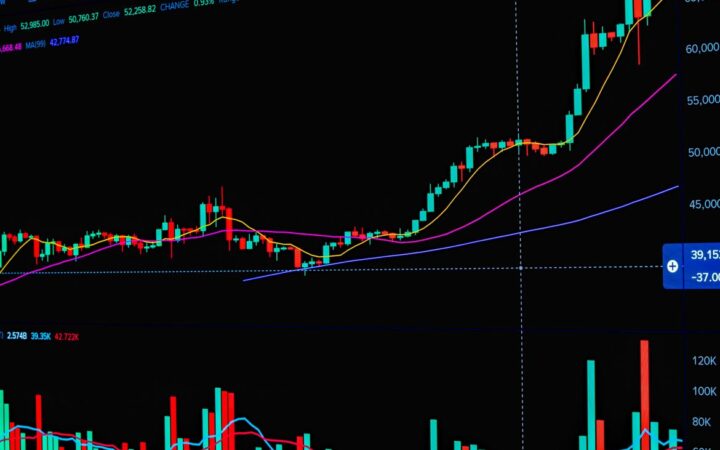
The global cryptocurrency market reacted aggressively on Monday morning as a major geopolitical breakthrough sparked a strong risk-on rally. Bitcoin (BTC) surged to a 12-day high, falling just shy of the $66,000 threshold at $65,881 on Coinbase. The sudden market momentum followed a late-night announcement by US President Donald Trump claiming that a comprehensive peace agreement had been brokered with the Islamic Republic of Iran to resolve the three-month conflict that has locked down regional shipping lines.
Taking to his Truth Social platform on Sunday evening, Trump declared that the United States and Iran had finalized a deal ensuring a “toll-free opening of the Strait of Hormuz”. In his characteristically direct messaging style, Trump authorized the immediate termination of the US naval blockade, signaling a restoration of global oil and gas supply channels through the critical maritime chokepoint.
Iranian state television subsequently verified the diplomatic de-escalation, with Deputy Foreign Minister Kazem Gharibabadi and the Supreme National Security Council confirming that hostilities across all active fronts would cease permanently. Pakistan, which acted as an intermediary during the intense negotiations, indicated that an official memorandum of understanding is slated for a formal signing in Switzerland this coming Friday.
Geopolitical De-escalation Spurs Risk-On Capital Rotation
The sudden cooling of Middle Eastern geopolitical tensions immediately stripped out the risk premium that had weighed heavily on broader financial markets since the conflict erupted with joint US-Israeli airstrikes. Analysts noted that the prospect of normalized shipping traffic through the Strait of Hormuz, which dictates the passage of roughly 20% of global petroleum supplies, triggered an immediate selloff in energy commodities. West Texas Intermediate (WTI) Crude plummeted 4.9% to a low of $80.75 per barrel, while Brent Crude mirrored the sharp correction by sliding 4.2% to $83.68.
This sudden drop in oil pressure catalyzed a swift capital rotation back into digital assets. Market research leads observed that moving past the immediate blockade threat directly alleviated systemic macro uncertainty, giving traders a clear runway to re-enter risk assets. Beyond Bitcoin’s rapid approach toward $66,000, the cumulative crypto market capitalization climbed 2% on the day. Several highly liquid altcoins logged double-digit percentage gains, with Hyperliquid (HYPE), Zcash (ZEC), and Near Protocol (NEAR) notably leading the broader market’s upward trajectory. Despite this relief rally, digital asset valuations are still fighting to erase long-term losses, with Bitcoin trading roughly 48% below its historic October peak of over $126,000.
Federal Reserve Transition Hints at Volatility Ahead
While the geopolitical breakthrough provided an immediate lift, institutional market participants are already bracing for a potentially volatile macroeconomic shift later in the week. On Wednesday, the Federal Reserve’s Federal Open Market Committee (FOMC) will convene its highly anticipated interest rate policy meeting. This marks the very first rate decision under the leadership of the newly appointed Federal Reserve Chairman, Kevin Warsh, who was sworn into office in late May.
The incoming central bank head faces an incredibly delicate economic backdrop. Although Warsh has historically expressed open receptivity toward implementing rate cuts, aligning with consistent pressure from the executive branch, unyielding consumer price pressures have severely complicated the Fed’s trajectory. Domestic inflation indicators have ticked past 4% once again, strengthening the underlying structural argument for maintaining a restrictive, hawkish monetary stance to firmly stamp out systemic inflation.
The CME FedWatch tool heavily reflects this complex reality, pinning a dominant 96.6% probability that the FOMC will ultimately vote to keep the benchmark federal funds rate entirely unchanged at its current 3.5% to 3.75% corridor. Digital asset traders are parsing these metrics carefully, aware that any unexpected forward guidance or hawkish policy surprises from Chairman Warsh’s inaugural press conference could swiftly blunt the momentum generated by the historic Middle East peace announcement
Disclaimer: CoinScreamer is an independent media brand owned and operated by NuvexMedia LLC, publishing news, research, and market insights on digital assets and related technologies. NuvexMedia LLC invests in and collaborates with companies across the digital asset, blockchain, and technology sectors. These relationships do not influence CoinScreamer’s editorial coverage, and the publication maintains full editorial independence to provide accurate, timely, and objective information. © 2025 NuvexMedia LLC. All rights reserved. This content is for informational purposes only and should not be considered legal, tax, investment, financial, or other professional advice.