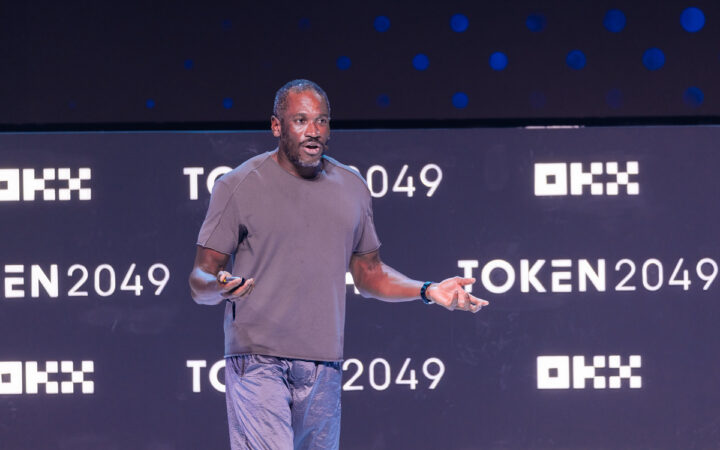
In a moment that may be remembered as the “Sovereign Pivot,” Aleš Michl, Governor of the Czech National Bank (CNB), took the stage at the Bitcoin 2026 conference in Las Vegas to argue that Bitcoin is no longer a fringe asset, but a necessary component of modern central bank reserves.
Michl, who oversees approximately $180 billion in reserves, equivalent to 44% of the Czech Republic’s GDP, used his keynote to present a data-driven defense of the digital asset, declaring simply:
“This is the future.”
“1% Rule” for Sovereign Portfolios
The core of Michl’s presentation rested on a new internal CNB study analyzing the impact of Bitcoin on traditional reserve portfolios. According to the findings, adding just a 1% allocation of Bitcoin significantly increases expected returns while leaving the overall risk profile virtually unchanged.
The secret, Michl explained, lies in low correlation. While Bitcoin is volatile, its price movements do not move in lockstep with the gold, fiat currencies, or sovereign bonds that typically dominate central bank vaults.
“Central bank and Bitcoin — most people do not put these two things together. I do. Concentration in any single asset is unwise. Our study shows that a small allocation to Bitcoin provides the diversification traditional assets can no longer offer alone,” Aleš Michl, CNB Governor, stated.
CNB’s Path to Sovereign Adoption
The Governor’s speech was not a sudden policy shift but the culmination of a strategy that began years ago.
In January 2025, Michl first publicly floated the idea of BTC as a diversification tool.
In mid-2025, the CNB board approved a 5% allocation limit for deeper analysis.
Later, in November 2025, the CNB executed its first digital asset purchase, becoming a closely watched pioneer among its global peers.
Rebutting the European Central Bank (ECB)
The speech served as a direct challenge to the long-standing skepticism of the European Central Bank. Štěpán Uherík, CFO of the Prague-based hardware wallet manufacturer Trezor, noted that Michl’s data effectively dismantles the “illiquid and unsafe” narrative often pushed by Brussels.
“The ECB has argued that Bitcoin is not liquid or secure enough for reserves,” Uherík said. “Governor Michl just presented a study showing the opposite. At some point, the question stops being about Bitcoin’s readiness and starts being about whether other central banks can afford to ignore what the Czech National Bank has found.”
The Czech Republic has a deep-rooted Bitcoin culture. Prague was the birthplace of the world’s first mining pool (Slush Pool) and the first hardware wallet (Trezor). By bringing Bitcoin into the CNB’s $180 billion portfolio, the institution is essentially catching up to the “builders” who have called Prague home since 2011.
As central banks worldwide grapple with inflation and geopolitical shifts, the “Czech Model” provides a blueprint for how a disciplined, data-driven institution can integrate the world’s largest cryptocurrency without sacrificing its mandate of stability.
Disclaimer: CoinScreamer is an independent media brand owned and operated by NuvexMedia LLC, publishing news, research, and market insights on digital assets and related technologies. NuvexMedia LLC invests in and collaborates with companies across the digital asset, blockchain, and technology sectors. These relationships do not influence CoinScreamer’s editorial coverage, and the publication maintains full editorial independence to provide accurate, timely, and objective information. © 2025 NuvexMedia LLC. All rights reserved. This content is for informational purposes only and should not be considered legal, tax, investment, financial, or other professional advice.