Bitcoin fell under $95,000 amid a broad four-day decline triggered by heavy losses in AI and tech stocks, mounting macro pressures and thinning crypto-specific flows.
By Sophie Anders
Published:
Updated:
Bitcoin drops below $95,000 as tech stocks, AI narratives and liquidity pressure converge to push crypto markets lower. Photo: Kanchanara / Unsplash
Bitcoin, the world’s largest cryptocurrency by market capitalization, fell below $95,000 on Friday, continuing a four-day decline that has caught the attention of investors across both crypto and equity markets.
The digital asset was trading around $94,896, down approximately 3.5% for the day, and has now shed a substantial portion of its recent gains. Earlier in the week, Bitcoin briefly reclaimed roughly $107,000 before sliding sharply lower.
This sell-off comes against a backdrop of heavy losses in artificial intelligence (AI) and growth-oriented technology stocks. Many of these same investor flows once supported risk-assets such as Bitcoin.
With the Nasdaq-100 futures down more than 1% in early trade, major names including Meta, Alphabet, Intel, Nvidia and Tesla all lost between 1%-5% in pre-market sessions. The linkage between Bitcoin and tech equities has grown more apparent as institutional participation in crypto deepens.
Crypto-equity Correlation Intensifies
Crypto-linked equities were among the hardest hit during this move. Shares of Strategy Inc. (formerly MicroStrategy) fell around 6%, while digital-asset platforms such as Coinbase Global, Inc. and Gemini Space Station dropped roughly 5%.
Mining and infrastructure stocks, including BitMine Immersion Technologies, also traded down by about 5%. The decline in both crypto and associated equities suggests a tilt toward risk-off sentiment rather than isolated crypto-specific issues.
Recent research indicates Bitcoin’s correlation with major equity indices has surged – reaching correlation levels above 0.80 in some periods – signifying that Bitcoin is increasingly behaving like a high-beta tech asset rather than an uncorrelated store of value. This dynamic means shocks to technology and growth sectors are now more likely to translate directly into crypto market stress.
Liquidity Pressures and Macro Triggers
Beyond the tech sell-off, several macro-level factors are exerting pressure. Analysts at banks such as Citi point to declining bank reserves and tightening liquidity as contributing to the Bitcoin retreat.
The flagging of over $300 billion in crypto market value erased in recent weeks underscores how thin crypto’s support may be when risk sentiment turns. One firm called the current phase a “sell-now, ask-questions-later” moment, detecting weak inflows and rising downside protection activity.
On-chain data reinforce this view: large volumes of Bitcoin – over 235,000 BTC worth approximately $24 billion – were moved at a loss in a 24-hour span, suggesting sellers are forcing capitulations. With fewer new buyers stepping up, many market watchers view this as a liquidity-driven stall rather than a fundamental breakdown in Bitcoin’s long-term thesis.
Technical View & Near-Term Implications
From a technical perspective, Bitcoin’s slip below the key support zone around $100,000 is significant. It has triggered warnings that the market may now enter a corrective phase rather than simply a dip. Historically, when Bitcoin breaches major psychological thresholds without robust buy-the-dip flows, the prospect of a deeper draw-down grows.
However, long-term adoption factors remain intact. Institutional entry is still unfolding, and many allocators continue to regard Bitcoin as digital gold and a hedge against inflation. The current pull-back may therefore represent a reset rather than a reversal of the bullish case—though the timing and magnitude of the recovery remain uncertain.
R25 has launched its on-chain RWA stablecoin platform on Polygon, debuting rcUSD+, a yield-bearing, dollar-pegged token backed by money market funds and structured notes.
By Sophie Anders
Published:
Updated:
R25 debuts rcUSD+, a yield-bearing, asset-backed stablecoin on Polygon’s on-chain RWA infrastructure. Photo: Polygon / X
R25, a new real-world asset (RWA) and stablecoin platform, has launched its on-chain protocol with Polygon as its first blockchain partner. The debut introduces rcUSD+, a yield-bearing stablecoin designed to maintain a one-to-one dollar peg while paying returns sourced from a portfolio of money market funds, structured notes, and short-duration traditional financial instruments.
Institutional-grade assets need institutional-grade rails.
R25 Protocol has officially launched on Polygon as its first and preferred EVM chain, introducing its rcUSD+ yield-bearing token, backed by a professionally managed portfolio of RWAs.
The launch positions R25 within the rapidly expanding market for asset-backed digital dollars, offering users a stablecoin backed by regulated yield sources rather than crypto-native mechanisms. Polygon co-founder Sandeep Nailwal said the collaboration aims to bring “institutional-quality real-world assets onchain,” noting that R25’s risk-managed structure “will provide immense value to both users and protocols building here.”
R25 said rcUSD+ is supported by multiple layers of credit enhancements, including over-collateralization and diversified short-term treasuries intended to strengthen its creditworthiness. The token is expected to be fully composable across Polygon’s DeFi ecosystem, enabling use as lending collateral, liquidity pool backing, and treasury management infrastructure for decentralized applications.
RWAs Move Into the Institutional Phase
The debut of rcUSD+ comes amid a surge of institutional interest in tokenized real-world assets. According to market research, the global RWA market—currently estimated around $35 billion – could expand to as much as $2 trillion by 2028. Much of this growth is expected to land on Ethereum and its scaling networks, with Layer 2s like Polygon competing aggressively to capture issuance and liquidity.
Analysts say yield-bearing stablecoins are narrowing the gap between traditional finance and crypto by offering institutional-grade income products to on-chain users. While only a small fraction of crypto assets currently produce yield, between 8% and 11%, traditional finance sees yield rates across 55% to 65% of assets. The rise of tokenized U.S. Treasuries, cash-equivalent portfolios, and structured credit is now accelerating the maturation of DeFi’s capital markets.
Part of a Larger Institutional On-Chain Shift
Polygon has become a leading network for tokenized treasury products, enterprise settlement rails, and real-world asset issuance. Integrations such as Calastone’s on-chain fund distribution and the adoption of institutional stablecoins have strengthened the network’s positioning in the RWA category. The launch of R25’s rcUSD+ adds another institutional-facing product to Polygon’s growing list of asset-backed initiatives.
For R25, the next phase will focus on expanding rcUSD+ integrations across DeFi, onboarding institutional liquidity providers, and exploring additional yield-bearing instruments. The protocol aims to bridge traditional fixed-income markets with programmable, on-chain finance – bringing institutional credit structures directly into decentralized applications.
With investors increasingly seeking stable, yield-generating digital assets and global capital beginning to flow into tokenized markets, R25’s arrival underscores a broader shift: the convergence of regulated traditional finance and permissionless DeFi infrastructure is no longer theoretical – it is rapidly becoming the new standard.
Global funds network Calastone is rolling out tokenized fund share classes on Polygon’s Layer 2 infrastructure, enabling its network of 4,500 institutions across 58 markets to distribute fund shares on-chain.
By Sophie Anders
Published:
Updated:
Calastone integrates its tokenised distribution solution with Polygon’s blockchain infrastructure to streamline institutional fund distribution. Photo: Polygon Labs UI Ltd.
Calastone, the London-based global funds network, has integrated its Tokenised Distribution platform with the Polygon blockchain, enabling fund managers to issue and distribute tokenized fund share classes directly on-chain.
The rollout extends across Calastone’s global network of 4,500 financial institutions operating in over 50 markets, representing one of the most significant institutional tokenization deployments to date.
Under the new model, fund share classes – digital representations of traditional mutual fund or ETF units backed 1:1 by regulated fund assets – can move and settle via Polygon’s high-speed Layer 2 infrastructure.
Calastone said the shift is designed to streamline global fund servicing and unlock new forms of digital distribution while maintaining full compatibility with existing administrative and regulatory processes.
“Markets are demanding more efficient, transparent infrastructure, and blockchain is ready to deliver at scale,” said Simon Keefe, Calastone’s Head of Digital Solutions. He added that integrating with Polygon allows Calastone’s tokenized distribution platform to link its global fund network with the speed, programmability, and settlement capabilities of on-chain environments.
Operational Efficiency and Expanded Access
Calastone emphasized that the tokenized share classes do not require changes to a fund’s existing structure, custody model, or servicing workflow. Instead, fund managers gain access to new digital-native distribution channels and blockchain-based liquidity pools.
The approach aims to reduce settlement times, lower operational costs, and bring greater transparency to fund operations without introducing friction into the current asset-management stack.
The integration also enables institutions to engage with on-chain capital pools – such as tokenized treasury instruments, digital cash, and blockchain-based investor networks – while preserving traditional compliance, reporting, and oversight mechanisms.
Institutional Tokenization at Scale
Calastone’s platform first launched earlier this year across Ethereum, Polygon, and Canton, but the latest phase marks the point where live institutional flows can be processed entirely on-chain. With more than £250 billion in monthly fund activity, Calastone’s tokenized network has the potential to bring large-scale operational efficiency to the asset-management sector.
Industry analysts say the move represents a turning point in institutional tokenization, offering a pathway for asset managers to modernize distribution models without the disruption typically associated with blockchain adoption.
As tokenized real-world assets, digital fund units, and blockchain-native liquidity continue to grow, Calastone’s Polygon integration could become a blueprint for next-generation fund infrastructure.
Circle Internet Group posted $740 million in third-quarter revenue and reserve income – 66 % year-on-year growth – as USDC circulation surged and the company advanced its Arc blockchain initiative.
By Sophie Anders
Published:
Updated:
Circle Internet Group sees strong Q3 results with USDC circulation topping $73 billion and the Arc public testnet rolling out with over 100 participants. Photo: Circle Internet Group, Inc
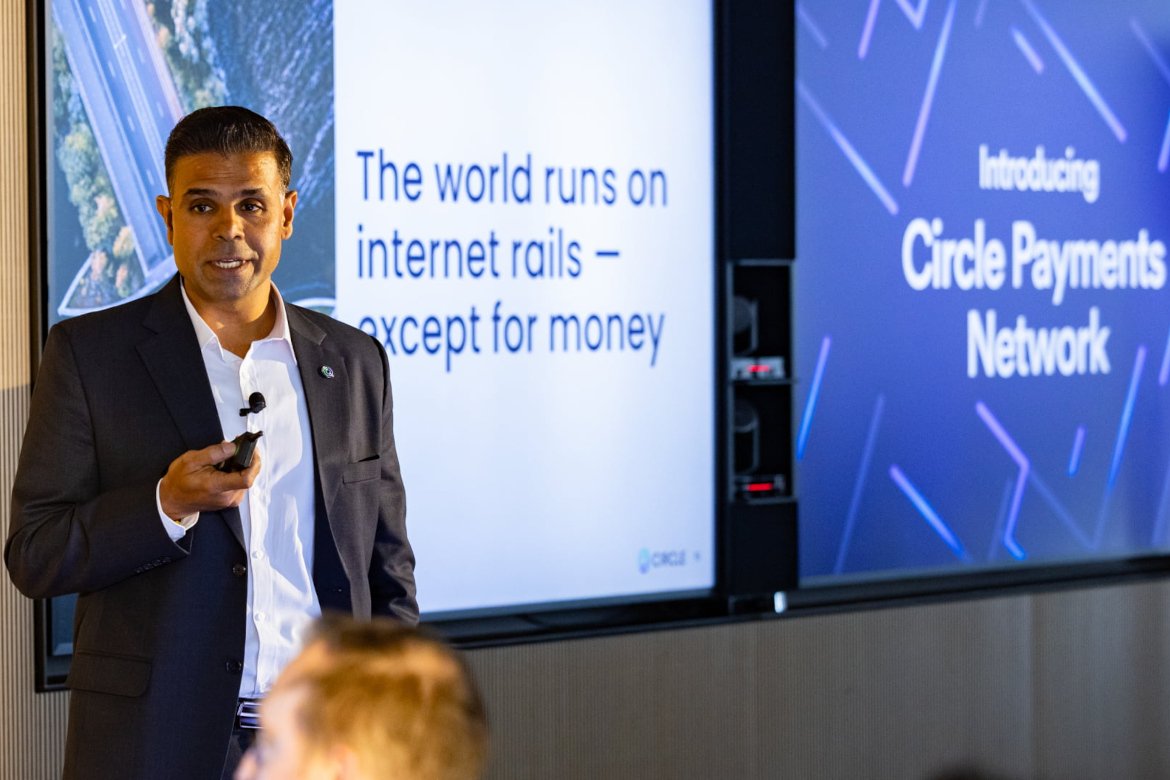
Circle Internet Group (NYSE: CRCL) delivered a strong third quarter in 2025, reporting $740 million in combined revenue and reserve income – a 66 % increase compared with the same period a year ago. The results were driven primarily by the rapid growth of the company’s stablecoin business, backed by the fiat- and Treasury-supported USDC.
At quarter end, USDC circulation reached $73.7 billion, more than double (up 108 %) the level a year prior. Many observers view this as a meaningful inflection point in the firm’s stablecoin franchise, which now commands roughly 29 % of the dollar-backed stablecoin market.
Growth Engines and Platform Ambitions
CEO and co-founder Jeremy Allaire said the quarter reflects “accelerating adoption of USDC and our platform” as Circle lays the groundwork for what it calls the “new Economic OS for the internet.”
A major highlight was the launch of the public testnet for Circle’s Arc layer-1 blockchain in October, which enlisted over 100 institutions including major banks, asset managers, payments firms and crypto exchanges. Circle is also exploring the possibility of launching a native Arc token.
In addition to its stablecoin business, Circle’s subsidiary operations show broader traction: the Circle Payments Network (CPN) now includes 29 enrolled financial institutions with 55 additional in eligibility review and 500 in the pipeline. These developments reflect Circle’s push into global payments, merchant flows and institutional finance.
Margin Trends, Costs and Market Reaction
While top-line growth was robust, some metrics point to rising pressure. The company noted that the RLDC margin (“revenue less distribution costs”) fell modestly to 39 %, down approximately 270 basis points year-on-year, due to higher distribution and transaction costs tied to expanding USDC balances.
Operating expenses also increased materially, with the 2025 revised guidance placing adjusted operating expenses in the range of $495-$510 million, up from earlier estimates.
Despite strong fundamentals, Circle’s stock traded lower in pre-market sessions, as investors weighed the valuation, rising cost base and sensitivity to interest-rate movements. Analysts remain split: some bullish on stablecoin dominance and platform build-out, others cautious about margin erosion and regulatory risks.
Outlook and Strategy Beyond Q3
Looking ahead, Circle raised its 2025 “Other Revenue” guidance to $90-$100 million (from earlier $75-$85 million), while reaffirming its long-term objective for USDC growth at a multi-year annualised rate above 40 %.
However, the company acknowledges external risks – most notably a potential decline in short-term interest rates which could compress reserve income, a major revenue driver derived from backing USDC with high-quality liquid assets.
Circle is betting the business will evolve from stablecoin issuance toward a broader ecosystem role: programmable money, institutional rails, and blockchain infrastructure underpinning global finance. If Arc and partner integrations scale as hoped, Circle aims to shift from pure reserve-income dependence toward a diversified platform model.
JPMorgan has deployed its blockchain-based deposit token, JPM Coin (JPMD), on Coinbase’s Base network – marking the bank’s first payment product on a public blockchain and a milestone in on-chain banking.
By Sophie Anders
Published:
Updated:
JPMorgan introduces its dollar deposit token on Coinbase’s Base network, signaling the next phase of institutional blockchain adoption. Photo: JPMorgan Chase & Co.
JPMorgan Chase has officially launched its dollar deposit token (JPMD) on Coinbase’s Base network, marking the first time the banking giant has deployed a native payment product on a public blockchain.
The move expands JPMorgan’s blockchain operations beyond its long-standing private networks and represents a major step toward the on-chain integration of traditional banking services.
The deposit token will initially be available to institutional clients, allowing transactions to settle instantly and around the clock via the Ethereum Layer 2 network. Unlike traditional wire transfers, which can take several business days, JPMD transactions will clear in seconds.
The token will also be accepted as collateral on Coinbase, with plans to expand to additional currencies and blockchains pending regulatory approval.
Deposit Tokens vs. Stablecoins
JPMorgan’s deposit token differs fundamentally from stablecoins like USDC or Tether (USDT). While stablecoins are issued by private entities and backed by external reserves, deposit tokens represent actual deposits held within a regulated bank. Each token carries the same claim on the bank as a standard account balance but operates natively on blockchain rails.
According to Naveen Mallela, global co-head of JPMorgan’s blockchain division Kinexys, deposit tokens offer institutions “a compelling alternative to stablecoins” that can be yield-bearing while maintaining full regulatory compliance. The bank’s next steps include developing a euro-denominated version, dubbed JPME, and expanding cross-border settlement capabilities as oversight frameworks evolve.
Institutional Integration and Risk Considerations
The JPMD rollout follows a successful trial period with Mastercard, Coinbase, and liquidity provider B2C2, during which JPMorgan tested real-time settlement and collateralization use cases.
The initiative builds on the bank’s broader digital asset expansion, which in recent months has included tokenized U.S. Treasuries on Chainlink, 24/7 client settlements with Brevan Howard Digital, and acceptance of Bitcoin, Ethereum, and crypto ETFs as loan collateral.
Industry analysts view the launch as a defining moment for on-chain banking, though not without challenges. Musheer Ahmed, Managing Director of Finstep Asia, cautioned that banks must address data privacy, anti-money-laundering risks, and blockchain reliability before scaling globally. Despite these hurdles, he said, deposit tokens “enable higher efficiency and move financial institutions toward a 24/7 financial ecosystem.”
Bridging Traditional Finance and Blockchain
The introduction of JPMD underscores JPMorgan’s conviction that blockchain will become integral to commercial banking. The Base network—a Layer 2 Ethereum scaling solution built by Coinbase – serves as the bridge connecting traditional deposits to decentralized finance. “Moving money should take seconds, not days,” the Base team said earlier this year.
While the deposit token is currently restricted to institutional use, JPMorgan plans to broaden access once regulators approve, potentially transforming how corporate and interbank settlements are conducted. As the world’s largest bank by market capitalization brings its deposits on-chain, the line between legacy banking and digital finance continues to blur – signaling that blockchain’s institutional era has officially begun.
Coinbase has unveiled a new platform for digital token offerings, with Layer-1 blockchain Monad set to be the first project to sell its token through the exchange’s regulated framework.
By Sophie Anders
Published:
Updated:
Coinbase introduces a regulated digital token offering platform, debuting with Monad’s upcoming MON sale. Photo: Coinbase
Coinbase, the largest U.S. cryptocurrency exchange, has launched a new digital token offering platform designed to bring transparency and regulatory oversight to on-chain capital formation. The move positions Coinbase at the forefront of compliant token distribution and marks a significant evolution in how blockchain startups raise funds.
The platform’s inaugural listing will feature Monad, a next-generation Layer-1 blockchain known for its high-speed, EVM-compatible architecture. Monad’s MON token sale will be the first conducted under Coinbase’s new framework, integrating know-your-customer (KYC) and anti-money-laundering (AML) procedures to align with U.S. securities and financial regulations.
Redefining Token Distribution in the U.S.
Coinbase said the new platform aims to bridge the gap between traditional capital markets and the on-chain economy, enabling vetted projects to issue tokens in a fully compliant environment. The system leverages Coinbase’s custody and trading infrastructure while allowing investors to access token offerings directly from their verified accounts.
Industry observers view the launch as Coinbase’s response to increasing regulatory clarity following the passage of the GENIUS Act, which has established a legal framework for stablecoins and digital asset issuances. By creating a regulated distribution model, Coinbase seeks to attract institutional participation and restore confidence to token launches after years of unregulated initial coin offerings.
Monad’s Strategic Debut
For Monad, the partnership with Coinbase represents a high-profile validation ahead of its mainnet launch on November 24. The blockchain has already drawn attention for its parallel transaction engine and focus on developer-friendly infrastructure capable of rivaling Solana’s throughput while maintaining Ethereum compatibility.
Monad’s public airdrop and token allocation program have fueled strong community anticipation, and the Coinbase listing gives the project a mainstream launchpad with built-in compliance and liquidity support. “We believe regulated exchanges will become the foundation for legitimate token markets,” a Monad spokesperson said.
Broader Market Implications
Analysts say Coinbase’s entry into token distribution could reshape how early-stage blockchain projects raise funds in the United States. By blending traditional exchange vetting with blockchain transparency, the model could accelerate institutional adoption while reducing regulatory risk.
If successful, Coinbase’s new platform may set a precedent for tokenized capital markets, giving startups a compliant path to issue assets and giving investors safer access to emerging blockchain ecosystems. For now, all eyes are on Monad’s launch — the first real-world test of Coinbase’s new approach to on-chain funding.
Kazakhstan is creating a national crypto-asset fund worth up to $1 billion, using seized digital wallets and targeting investments in ETFs and blockchain-linked companies.
By Sophie Anders
Published:
Updated:
Kazakhstan moves to institutionalize crypto holdings with a $1 billion state-backed fund, signaling its shift toward digital finance and diversification beyond oil. Photo: Viktor Hesse / Unsplash
Kazakhstan is preparing to launch a national cryptocurrency reserve fund valued between $500 million and $1 billion, marking a major milestone in the country’s push to integrate digital assets into its sovereign investment strategy.
The fund will be built using seized and repatriated crypto assets as well as proceeds from state-backed bitcoin mining operations, according to Central Bank Governor Timur Suleimenov. The initiative, expected to debut by early 2026, positions Kazakhstan as one of the first nations to incorporate digital assets into a formal sovereign wealth framework.
Suleimenov said in London this week that the fund will take a “measured and regulated approach,” focusing on exchange-traded funds (ETFs) and shares of digital finance companies rather than direct cryptocurrency holdings. “We will be very careful about direct exposure to cryptocurrencies,” he noted, emphasizing a preference for structured, low-volatility investment vehicles.
Turning Seized Assets into Strategic Capital
Plans for a state-managed crypto fund first surfaced in 2024, when Kazakhstan’s Agency for Financial Monitoring proposed consolidating confiscated digital wallets and tokens into a national reserve. The effort aims to repurpose illicitly obtained or dormant crypto holdings into productive capital, strengthening economic sovereignty while promoting financial transparency.
By converting seized digital assets into regulated investments, Kazakhstan hopes to transform what was once a compliance and enforcement challenge into a long-term source of growth. The model mirrors similar efforts emerging in the United States and Europe, where governments have begun managing seized cryptocurrencies through official channels.
In the U.S., a crypto reserve established under a 2025 executive order functions as a strategic stockpile of government-held Bitcoin and other assets acquired through legal forfeiture. Kazakhstan’s approach follows a similar philosophy – managing, rather than speculating with, existing holdings to reinforce national financial stability and digital resilience.
Diversification Beyond Oil and Traditional Exports
For decades, Kazakhstan’s economy has been anchored by oil and gas exports, leaving it exposed to commodity price cycles. President Kassym-Jomart Tokayev has prioritized diversification through technology, innovation, and fintech – sectors increasingly central to the country’s modernization agenda.
The crypto reserve fund aligns with that broader vision. By channeling investments into blockchain infrastructure, fintech equities, and crypto-related ETFs, the central bank aims to capture value from the digital asset sector while sidestepping the volatility and custody risks of direct crypto ownership.
The initiative will operate under the Astana International Financial Centre (AIFC) – Kazakhstan’s fintech and regulatory hub – which is expected to oversee compliance, governance, and potential foreign investment partnerships. Over time, officials suggest that the fund may open to international co-investors, positioning Kazakhstan as a regional leader in regulated digital finance.
A Blueprint for Emerging Markets
The new fund also aligns with Kazakhstan’s ambition to become Central Asia’s primary fintech hub. It complements projects like Alatau CryptoCity, a government-backed innovation zone dedicated to blockchain startups, digital payments, and tokenized finance experiments.
If successful, the national crypto fund could serve as a blueprint for emerging economies looking to harness digital assets within state-controlled investment frameworks. By balancing innovation with regulatory prudence, Kazakhstan aims to bridge traditional and decentralized finance – turning seized crypto into sovereign strength.
Ripple has joined forces with Mastercard, Gemini, and WebBank to enable RLUSD stablecoin settlement for credit card transactions, marking a milestone in blockchain-based payments.
By Sophie Anders
Published:
Updated:
Ripple and Mastercard partner to integrate RLUSD stablecoin settlement for credit card payments on the XRPL blockchain. Photo: Ripple
Ripple, the company behind XRP and the RLUSD stablecoin, has announced a major partnership with Mastercard, Gemini, and WebBank to integrate stablecoins into credit card payments. The collaboration represents a significant step in merging traditional finance with blockchain-based settlement systems.
Under the new arrangement, purchases made with a Gemini-branded credit card will be settled in RLUSD, Ripple’s U.S. dollar–backed stablecoin. Settlement between Mastercard and WebBank – the Utah-based issuer of the Gemini card – will occur on Ripple’s XRPL blockchain, enabling faster and more transparent transactions.
“Mastercard is integrating regulated, open-loop stablecoins into our global payments network to support consumer choice and safety,” said Sherri Haymond, Mastercard’s head of digital commercialization. “We’re enabling stablecoin settlement today while exploring how these assets can enhance future blockchain use cases.”
Stablecoins Enter the Mainstream
The partnership highlights a growing push among major financial institutions to adopt regulated stablecoins. Ripple says this is among the first cases where a U.S. bank settles credit card transactions using stablecoins on a public blockchain.
The integration arrives amid a favorable regulatory climate following the passage of the GENIUS Act, a landmark U.S. stablecoin bill that has fueled optimism across the digital asset industry.
The stablecoin market, currently valued around $305 billion, is projected by analysts to reach $4 trillion by 2030. Major institutions including Zelle, Western Union, Wells Fargo, Santander, and Société Générale have recently announced initiatives to leverage stablecoin infrastructure. Mastercard, meanwhile, is reportedly in advanced talks to acquire stablecoin startup Zerohash in a deal estimated at up to $2 billion.
Ripple’s Expanding Financial Footprint
Ripple’s RLUSD stablecoin, launched in 2024, is backed by U.S. dollar deposits, short-term Treasuries, and cash equivalents. It has rapidly grown to become the 11th-largest stablecoin globally, with a market capitalization of just over $1 billion.
The company has been expanding aggressively across financial services, including payments, custody, and treasury management through its acquisition of GTreasury, a firm that services Fortune 500 clients.
Speaking at Ripple’s Swell conference in New York, GTreasury CEO Renaat Ver Eecke said stablecoins could dramatically reduce settlement times in corporate finance. “What if we could reduce settlement times to minutes?” he said. “Clients immediately recognize the liquidity potential that creates.”
Initial onboarding for the Ripple-Mastercard partnership will begin in the coming months, subject to regulatory approval. If successful, the collaboration could become a blueprint for integrating stablecoins into everyday consumer payments.
Monad will launch its Layer 1 blockchain and native token on November 24, marking one of the year’s most anticipated crypto network debuts, alongside a large-scale community airdrop.
By Sophie Anders
Published:
Updated:
Monad prepares for its public mainnet and token airdrop, signaling one of the most anticipated blockchain launches of the year. Photo: Monad Foundation./ X
Monad, a next-generation Layer 1 blockchain, will officially launch its public mainnet and native MON token on November 24 at 9 a.m. ET, according to the Monad Foundation. The long-awaited rollout follows months of speculation and community buildup, making it one of the most closely watched network launches in the crypto ecosystem this year.
The Monad Foundation opened a token claim portal in October, allowing users to view allocations and connect their wallets ahead of the airdrop. The initial surge of traffic briefly caused performance issues for wallet partner Privy, highlighting the overwhelming interest in the event.
According to Monad’s team, the airdrop is designed to reward early ecosystem contributors and onchain participants across major decentralized finance and NFT platforms.
Community Distribution and Ecosystem Vision
The airdrop includes allocations for roughly 225,000 verified users, spanning decentralized exchanges such as Uniswap and Hyperliquid, lending protocols like Aave, Euler, and Morpho, as well as participants in NFT communities and DAO governance initiatives.
Monad has also reserved tokens for educational efforts like RareSkills and SheFi, and for blockchain security researchers, including Protocol Guild and SEAL 911.
“Our goal is for community members to become significant stakeholders in Monad’s future,” the foundation stated, emphasizing that the network’s direction will be shaped by its earliest supporters and contributors.
Technology and Market Position
Founded in 2022, Monad raised $225 million to develop an EVM-compatible blockchain that aims to rival Solana’s transaction speed while maintaining Ethereum’s decentralization.
The protocol’s testnet, launched earlier this year, showcased its parallel execution engine and custom MonadDb database, enabling sub-second finality and thousands of transactions per second.
At launch, Monad will integrate with leading decentralized applications including Uniswap, Magic Eden, and OpenSea, and will support major crypto wallets such as OKX, Backpack, MetaMask, and Rabby.
While the exact tokenomics have yet to be revealed, the foundation’s ecosystem-driven distribution approach positions Monad as one of the most community-oriented blockchain launches of 2025.
Ripple has raised $500 million in a new funding round, pushing its valuation to $40 billion as it expands beyond payments into digital asset custody, stablecoins, and prime brokerage.
By Sophie Anders
Published:
Updated:
Ripple achieves a $40 billion valuation following a $500 million funding round led by major institutional investors. Photo: Sarjoun Faour / Ripple
Ripple has raised $500 million in fresh funding, boosting its valuation to $40 billion as the digital asset and infrastructure firm continues its rapid expansion beyond blockchain-based payments. The latest investment marks one of the largest private capital raises in the crypto sector this year.
The funding round was led by funds managed by affiliates of Fortress Investment Group, Citadel Securities, Pantera Capital, Galaxy Digital, Brevan Howard, and Marshall Wace. Ripple described the decision to accept new common equity as a strategic step to deepen relationships with key financial partners as it scales globally.
Expanding Beyond Payments
Founded in 2012, Ripple began by using blockchain technology to power cross-border payments, leveraging its XRP token to move fiat currencies quickly and efficiently. Over the past two years, however, the company has undergone a transformation into a comprehensive digital asset platform, completing six acquisitions and broadening its service offerings.
Ripple has launched its own stablecoin, introduced Ripple Prime for institutional crypto brokerage, and built out a custody and treasury management business aimed at corporate and financial clients. The company’s stablecoin, pegged to the U.S. dollar and backed by real assets, is now a core component of its strategy to modernize global liquidity and settlement networks.
Ripple’s International CEO, Michael Higgins, previously described the firm’s growth as a “record year,” noting the expansion of its U.S. presence through acquisitions and the rollout of institutional trading infrastructure. The company’s evolution reflects a wider trend of crypto firms moving toward regulated, enterprise-focused financial services.
Favorable U.S. Environment
The latest funding comes amid a more constructive environment for the U.S. digital asset industry. The passage of the GENIUS Act, a landmark stablecoin framework, and the election of President Donald Trump have renewed optimism among industry leaders about regulatory clarity and institutional participation.
Despite broader crypto market volatility—highlighted by Bitcoin’s recent dip below $100,000—Ripple’s fundraising underscores investor confidence in blockchain-driven financial infrastructure. With new capital and a diversified product base, the company appears well-positioned to strengthen its leadership role in the next phase of institutional crypto adoption.
BitMine Immersion Technologies reports total crypto and cash reserves of $13.7 billion, with Ethereum holdings now reaching 3.4 million tokens – representing 2.8% of the ETH supply.
By Sophie Anders
Published:
Updated:
BitMine Immersion strengthens its position as the leading Ethereum treasury, holding 3.4 million ETH and expanding institutional support. Photo: Traxer / Unsplash
BitMine Immersion Technologies (BMNR) has announced total crypto and cash holdings of $13.7 billion, further cementing its position as one of the largest digital asset treasuries in the world.
The company revealed that it now holds 3.4 million Ethereum (ETH) tokens – roughly 2.8% of the total ETH supply – alongside $389 million in unencumbered cash and smaller positions in Bitcoin and equity investments.
The Las Vegas–based firm, which focuses on long-term crypto accumulation through mining and investment, has become a standout among public blockchain companies for both the scale of its holdings and the liquidity of its stock. BitMine now ranks as the #60 most traded stock in the United States, with a five-day average daily volume of $1.5 billion, according to company data.
Ethereum Leadership and Institutional Support
BitMine’s chairman, Thomas “Tom” Lee of Fundstrat, highlighted the company’s growing influence within the Ethereum ecosystem. He noted that the recent accumulation of 82,000 ETH in a single week pushed the firm past the halfway mark toward its goal of owning 5% of all Ethereum, an objective Lee refers to as the “alchemy of 5%.”
Lee emphasized that Ethereum’s underlying fundamentals are strengthening, citing rising stablecoin supply and record-high application revenues as indicators of long-term momentum. Despite October’s severe liquidation event, Lee suggested that the resulting decline in leverage was a healthy reset for the market.
BitMine’s investor base includes ARK Invest, Founders Fund, Pantera Capital, Galaxy Digital, and several prominent institutional players. This support has positioned BitMine as a preferred vehicle for institutional exposure to Ethereum’s performance and broader crypto market trends.
Position Among Global Treasuries
BitMine’s crypto reserves place it second only to Strategy Inc. (MSTR) among global corporate crypto treasuries. While Strategy Inc. dominates Bitcoin holdings with 640,808 BTC, BitMine leads in Ethereum exposure.
The firm continues to expand its operations across low-cost energy regions in Texas and Trinidad, leveraging mining and synthetic hashrate products to increase its crypto net asset value per share.
As the company moves closer to its goal of acquiring 5% of Ethereum’s total supply, BitMine is positioning itself at the intersection of corporate treasury strategy, digital asset accumulation, and institutional-grade market liquidity.
Ripple has expanded into prime brokerage with the launch of Ripple Prime in the United States, allowing institutional clients to trade and manage a full range of digital asset products, including XRP and RLUSD.
By Sophie Anders
Published:
Updated:
Ripple expands its institutional reach with Ripple Prime, integrating spot, derivatives, and fixed-income digital asset services. Photo: Ripple
Ripple has launched digital asset spot prime brokerage services for U.S.-based institutional clients, marking a significant expansion of its trading and financial infrastructure. The move follows Ripple’s acquisition of Hidden Road, a multi-asset prime brokerage platform, earlier this year.
Operating under the new brand Ripple Prime, the platform will now allow clients to execute over-the-counter (OTC) spot transactions across dozens of leading digital assets, including XRP and Ripple’s stablecoin RLUSD.
The launch extends Ripple’s existing OTC derivatives and clearing services, providing a fully integrated suite for institutional investors seeking exposure to crypto markets under regulated conditions.
According to Ripple Prime’s International CEO Michael Higgins, the addition of OTC spot execution capabilities complements the company’s broader trading infrastructure. “It positions us to provide U.S. institutions with a comprehensive offering to suit their trading strategies and needs,” Higgins said in the announcement.
Institutional Expansion and Integration
Ripple Prime now supports a wide range of product types – including FX, derivatives, swaps, and fixed income – giving institutions unified access to digital and traditional financial instruments. The platform also enables cross-margining between OTC spot holdings and derivatives positions, allowing clients to manage exposure more efficiently across asset classes.
The acquisition of Hidden Road in October 2025 played a pivotal role in enabling Ripple’s expansion into prime brokerage. By integrating Hidden Road’s technology and licenses, Ripple has positioned itself to bridge the gap between digital assets and institutional finance, strengthening its role as a full-service provider for global markets.
Ripple continues to broaden its suite of institutional offerings, which includes Ripple Payments for cross-border settlements and Ripple Custody for secure digital asset storage. Through Ripple Prime, the company now provides U.S. clients with access to a multi-asset prime brokerage platform, reflecting the increasing convergence between crypto markets and traditional finance.